
10 Resume Red Flags From Real Recruiter Data — And How to Fix Each One

TL;DR
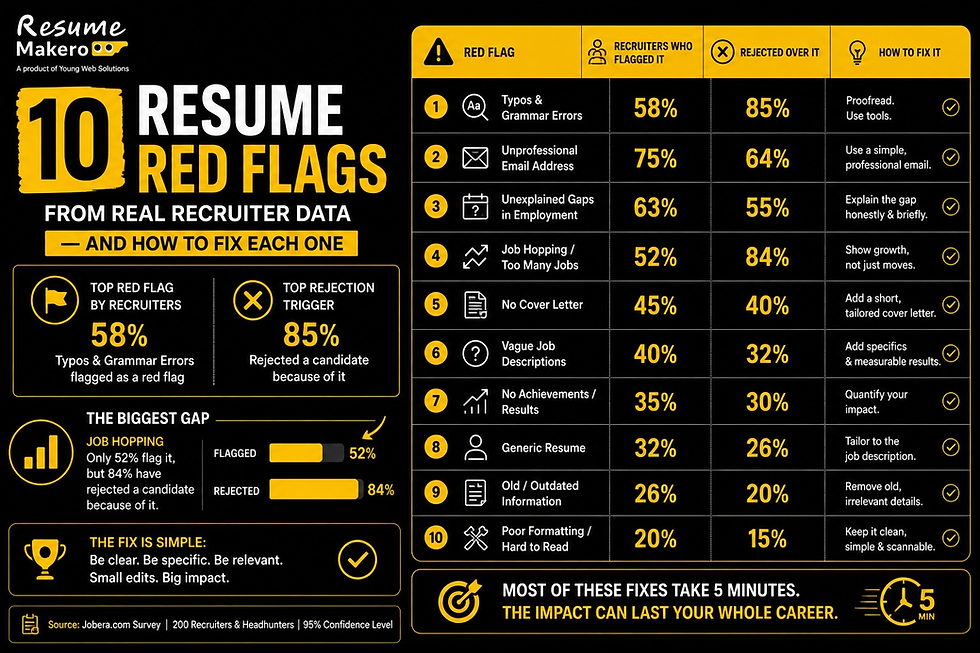
A survey of 200 recruiters and headhunters (Jobera.com, 95% confidence level) ranked resume red flags by how many recruiters flag them — and, separately, by how often each one actually causes rejection.
Typos and grammar errors top both lists: 58% of recruiters call them a red flag, and 85% say they've rejected a candidate over one.
The biggest gap between "flagged" and "fatal" is job hopping — only 52% call it out, but 84% admit it's actually cost a candidate the role.
Unprofessional email addresses are more damaging than most candidates assume: 75% of recruiters want a professional address, and 64% have rejected someone over it.
The fix for almost every item on this list is specificity: dates instead of vague ranges, achievements instead of duties, a tailored resume instead of a generic one.
None of this requires a redesign — most fixes are five-minute edits, not a rebuild.
Where This Data Comes From
Most "recruiter red flag" lists are opinion pieces. This one isn't. Jobera.com ran a survey of 200 recruiters and headhunters, with a 95% confidence level and a 3% margin of error — a large enough, rigorous enough sample to treat the resulting numbers as genuinely representative, not anecdotal. Two figures were captured for each red flag: how many recruiters consider it a red flag, and — the more useful number — how many have actually rejected a candidate because of it. The gap between those two numbers is often the real story.

The Top 10, Ranked by Recruiter Data
1. Typos and Grammar Errors — 58% flag it, 85% have rejected over it
The single most damaging mistake on the list, and the easiest to fix. Grammar and spelling errors read as a lack of attention to detail — a quality most job descriptions list as a requirement, even informally.
Fix: Read your resume backward, line by line, to catch errors your eyes skip when reading forward. Run it through a grammar checker, then have one other person read it before you send it.
2. Employment Gaps — 55% flag it, 69% have rejected over it
Unexplained gaps invite recruiters to assume the worst-case explanation, simply because no other explanation was offered.
Fix: Add a single line for any gap over a few months — a course completed, a project built, a freelance role, a personal reason stated plainly. One sentence closes the loop; silence doesn't.
3. Job Hopping — 52% flag it, 84% have rejected over it
This has one of the widest gaps between "considered a flag" and "actually fatal" on the entire list — recruiters may not always mention it, but it's quietly disqualifying more often than almost anything else on this list.
Fix: If you have a pattern of short stints, group similar short-term or contract roles under one heading, and use your summary to briefly frame the pattern (e.g., contract work, career pivot) before a recruiter has to guess.
4. Vague Job Descriptions — 50% flag it, 36% have rejected over it
Recruiters can't evaluate what they can't picture. Descriptions dressed in vague, impressive-sounding language without specifics leave them unable to confirm you actually did the work.
Fix: Replace every vague line with a specific one: what you did, what tool or method you used, and what changed as a result.
5. Unprofessional Email Address — 35% flag it, 64% have rejected over it
Another wide gap: fewer than half mention it as a red flag, but roughly two-thirds have rejected a candidate over it. This one is now purely avoidable.
Fix: Use a simple firstname.lastname@ format on a standard provider. Free, permanent, and takes two minutes to set up if you don't already have one.
6. Resume Formatting & Design — 30% flag it, 51% have rejected over it
A resume that opens as an editable file, has paragraphs jumping across the page, or mixes fonts and spacing inconsistently reads as a lack of basic organizational skill — regardless of how strong the content is underneath.
Fix: Use a single-column layout, one or two fonts, consistent spacing, and always export the final version as a PDF so formatting can't shift on someone else's device.
7. A Career Path That Doesn't Fit — 25% flag it, 83% have rejected over it
The second-widest gap on the list. Recruiters rarely name this directly, but when a candidate's trajectory doesn't logically lead to the role applied for, it's rejecting people at a very high rate.
Fix: Use your summary or objective line to explicitly bridge the gap — state the connective thread between your background and the role, rather than leaving the recruiter to infer it.
8. Lack of Resume Customization — 22% flag it, 56% have rejected over it
Generic, one-size-fits-all resumes are increasingly easy for recruiters to spot, especially when the same resume is clearly being mass-sent across unrelated roles.
Fix: Adjust your summary, skills order, and top 2–3 bullet points per job title to mirror the specific language in each job description you're applying to.
9. Lack of Career Progression — 22% flag it, 54% have rejected over it
Holding the same title or scope of responsibility across multiple years, with no visible growth, raises questions about ambition or performance — fair or not.
Fix: If your title didn't change but your responsibilities did, say so explicitly: added ownership, new tools, larger scope, mentoring — progression isn't only a title change.
10. Focusing on Responsibilities, Not Achievements — 20% flag it, 37% have rejected over it
Listing what you were responsible for tells a recruiter what your job was. Listing what you achieved tells them what you're capable of — and only one of those predicts future performance.
Fix: Rewrite each bullet in the format: action + what you did + measurable outcome. "Managed social accounts" becomes "Grew Instagram following by 40% in 6 months through a revised content calendar."

What Recruiters Actually Say About This
Fallon Chase, founder of Chase & Co., described resumes with formatting that jumps around the page or opens as an editable file as reading as unprofessional, since attention to detail is a baseline expectation for almost any role. Jennifer Preston, an HR consultant at Flex HR, has said resumes should stay brief but substantive — ideally one page, paired with a cover letter that pulls out the specific points that differentiate one candidate from another.
FAQ
What's the single most damaging resume red flag, according to recruiter data?
Typos and grammar errors — 58% of recruiters flag them, and 85% have rejected a candidate specifically because of one.
Which red flag has the biggest gap between how often it's mentioned and how often it actually causes rejection? A career path that doesn't logically fit the role applied for: only 25% of recruiters call it out directly, but 83% have rejected a candidate over it.
Does an unprofessional email address really matter that much?
Yes — 64% of recruiters in the survey said they've rejected a candidate partly because of an unprofessional email address, even though only 35% list it as a red flag upfront.
Is job hopping always a dealbreaker?
Not always, but the data shows it's rejected far more often than it's explicitly flagged — 84% of recruiters have rejected over it despite only 52% naming it as a concern. Framing short stints clearly (contract work, pivot, layoff) reduces the risk.
Do these red flags matter more for freshers or experienced professionals?
Most apply to both, but employment gaps, job hopping, and lack of career progression weigh more heavily for experienced professionals — freshers are generally judged more on formatting, grammar, and customization.
The gap between what recruiters say bothers them and what actually gets a resume rejected is the real insight in this data. Typos are the obvious one — everyone already knows to check for those. The dangerous ones are the quiet, high-rejection items further down the list: an unexplained career pivot, a pattern of short stints, a generic resume sent to every job. Fix those, and you're addressing the mistakes that are silently costing interviews, not just the ones that are easy to spot.
Want a resume that avoids all 10 by design? Build one for free on Resume Makero — clean formatting, built-in checks, no sign-up, no watermark.


