What Is ATS and Why an ATS Friendly Resume Matters in Modern Hiring
Updated: Jul 29
In the modern job market, access to opportunities is almost entirely mediated by software. Before a recruiter ever reviews your resume, it is processed by an Applicant Tracking System, commonly known as ATS. Understanding how ATS works and why an ATS friendly resume matters is essential for students, freshers, and professionals applying for jobs online.
This article explains the real role of ATS, clears common myths, and shows why resume structure and readability directly affect your chances of being noticed.
The Role of ATS in Today’s Hiring Process
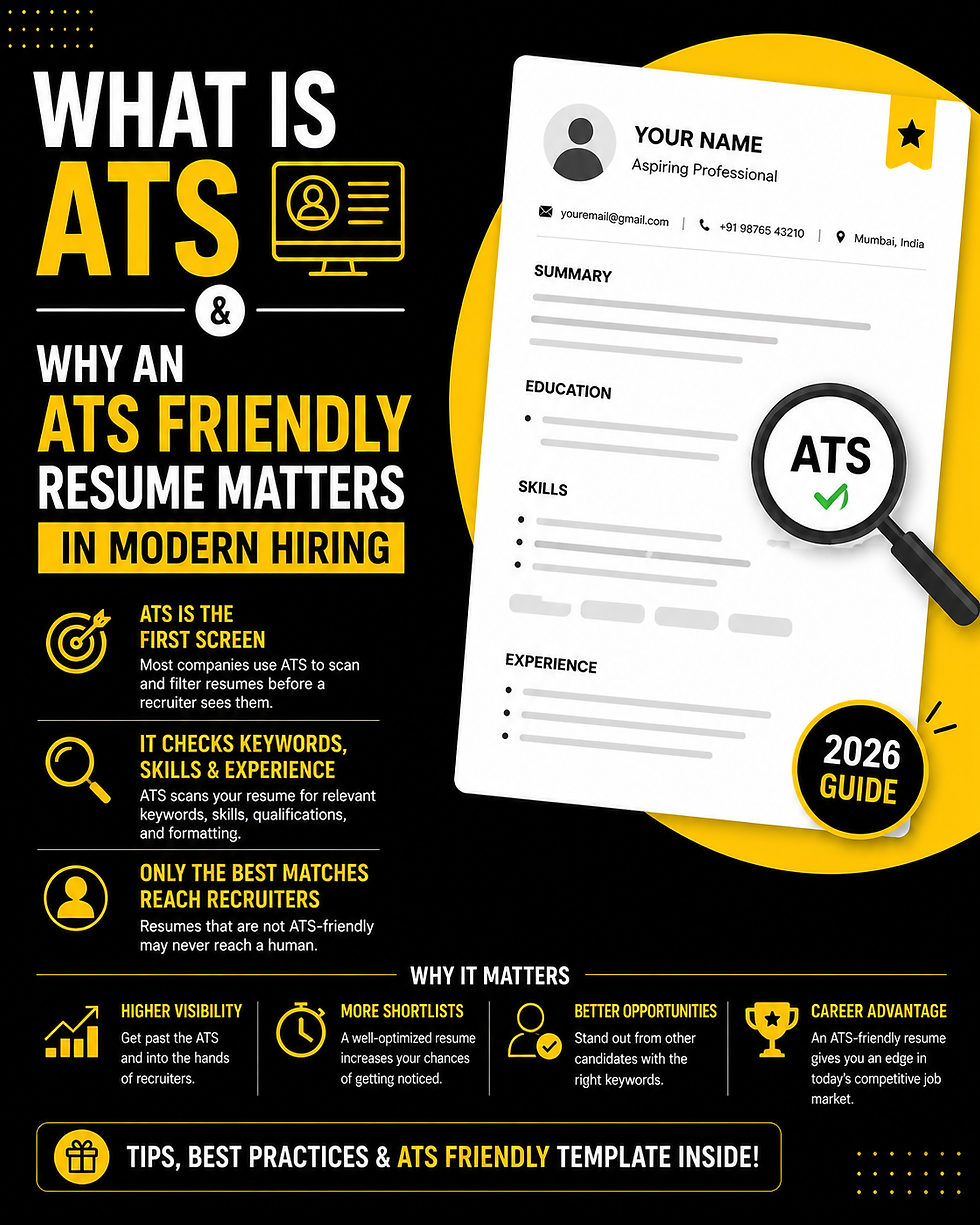
An Applicant Tracking System is hiring software used by companies to manage job applications efficiently. Employers often receive hundreds or even thousands of applications for a single role. Reviewing them manually is not feasible.
ATS is used to
Collect and store resumes
Extract information such as skills, education, and experience
Allow recruiters to search and filter candidates
Rank applications based on relevance
More than ninety percent of medium and large organizations worldwide rely on ATS as a core hiring tool.
The Biggest ATS Myth Explained
Many candidates believe ATS automatically rejects resumes using artificial intelligence. This belief is incorrect.
In most cases, resumes fail to progress for three main reasons.
Knockout Questions
These are mandatory eligibility questions such as work authorization, location, or required certifications. If a candidate answers incorrectly, the application is rejected instantly without resume review.
Ranking and Visibility
Most resumes are successfully stored in the system. Recruiters review only the top results shown by ATS searches. Lower ranked resumes are often never seen even though they were not formally rejected.
Resume Parsing Failure
If ATS cannot read a resume correctly, the candidate profile becomes incomplete. Missing skills, job titles, or contact details make the resume invisible in recruiter searches.
The real problem is not rejection by robots. It is invisibility caused by unreadable data.
How Resume Parsing Works
When you upload a resume, ATS does not store it as a visual document. It converts the resume into structured data through a parsing engine.
The parsing process includes
Extracting raw text from the file
Identifying sections such as Experience and Education
Detecting entities such as job titles, dates, and skills
Saving this information into searchable fields
If parsing fails, the resume may look perfect to a human but appear incomplete inside the system.
Why Resume Formatting Can Cause Failure
ATS parsers expect a simple linear document structure. Certain formatting choices commonly lead to errors.
Multiple Columns
Text may be read across the page instead of top to bottom, which mixes unrelated content and breaks chronology.
Tables and Text Boxes
Parsing engines struggle to determine reading order, which can result in missing or misplaced sections.
Graphics and Icons
ATS cannot read images. Skills represented visually may not be captured at all.
Headers and Footers
Contact details placed in headers may be ignored by some systems, leading to incomplete profiles.
Legacy ATS and Modern ATS
Different ATS platforms behave differently.
Legacy systems used by large enterprises and government organizations are strict and highly dependent on accurate parsing. Clean formatting is critical.
Modern systems used by startups and technology companies are more flexible visually but still rely on parsed data for searching and filtering.
Because applicants cannot know which system an employer uses, safe formatting is always the best approach.
Keywords and Modern ATS
Earlier ATS platforms depended on exact keyword matching. This created the practice of keyword stuffing.
Modern systems use semantic analysis. They understand related skills and context. Describing how you used a skill is more valuable than simply listing it.
Keyword stuffing, hidden text, and copying job descriptions no longer work and can harm credibility.
What ATS Friendly Really Means
An ATS friendly resume focuses on clarity and structure rather than design.
It means
A single column layout
Standard readable fonts
Clear section headings
Text based content
Consistent date formats
Simple PDF or DOCX files
These practices improve both machine readability and human review.
ATS Friendly Is Also Recruiter Friendly
Recruiters typically scan resumes in a few seconds. Clear formatting, logical flow, and readable text reduce effort and improve understanding.
A resume that works well for ATS almost always performs better with recruiters.
Why Resume Makero Focuses on ATS Friendly Resumes
Resume Makero is built around real hiring workflows.
It helps users
Create clean professional resumes
Use ATS optimized templates
Avoid formatting that breaks parsing
Download resumes instantly for free
Build resumes without sign up or data storage
The focus is on practicality, clarity, and accessibility.

Summary
Applicant Tracking Systems do not reject resumes based on appearance or artificial intelligence judgment. Resumes fail when they cannot be parsed correctly or when they are ranked too low to be seen. An ATS friendly resume ensures your information is readable, searchable, and visible to recruiters. In a hiring process driven by volume and software, clarity determines access. Creating an ATS friendly resume is not a trick or shortcut. It is a professional standard for succeeding in modern hiring.