Why Does Every Resume Builder Want Your Money Before You Even Apply?

TL;DR
Most "free" resume builders aren't actually free — they gate sign-up, downloads, or remove watermarks only after payment.
We built Resume Makero, a completely free, no-sign-up, ATS-friendly resume builder, by asking what to remove, not what to add.
The product's core rule: if a feature doesn't help someone get hired faster, it doesn't ship.
Below, we break down the biggest ATS resume myths (columns, keywords, Canva templates, resume length) that quietly get qualified candidates rejected before a human ever sees their resume.
Building our own SaaS product — not just client websites — taught Young Web Solutions how to validate, ship, and iterate faster, and it's now baked into how we build software for clients too.
If you need a resume today: try Resume Makero free. If you're building a product and want it built the same way: book a call with Young Web Solutions.
You finally find a job you actually want to apply for.
You open your resume file. It's fourteen months old and still says you're "seeking opportunities to grow" at a company you left in 2023.
So you do the reasonable thing. You open Google and type:
"Free resume builder."
Simple enough. Except it isn't.
The first site asks you to create an account before you've typed a single word. The second one lets you build the whole thing, then asks for ₹699 right before the download button. The third one is free — if you don't mind a watermark the size of your career ambitions sitting across your work experience.
By the time you've picked a resume builder, you've spent more time evaluating pricing tiers than actually applying for the job.
That's the exact moment we realized something: the resume was never the problem. The experience was.
We Weren't Trying to Build Another Resume Builder
Honestly, the internet doesn't need one.
There are resume builders with AI baked into every field. Builders with 500 templates.
Builders with features even their own founders have probably forgotten exist. Adding one more polished tool to that pile wasn't going to change anything for anyone.
So instead of asking the usual question — "What features should we add?" — we asked a more annoying one:
"What can we remove?"
That single question shaped the entire product.
Five Things We Refused to Do
We refused to... | So instead, we... |
Force sign-ups before letting people start | Let people start building immediately |
Lock the download behind a paywall | Made PDF and DOCX downloads free |
Slap a watermark across the resume | Removed watermarks entirely |
Build a cluttered, decision-heavy editor | Kept the UI ridiculously simple |
Prioritize aesthetics over hireability | Built around ATS compatibility first |
None of these decisions were about being "disruptive" or building a growth-hack. They came from one uncomfortable observation:
People come to create a resume, not another online account.
That sentence became our rule. Every time a new feature was proposed, we asked one question before building it:
Will this actually help someone get hired faster?
If the answer was no, it didn't make the cut — no matter how impressive it looked in a product meeting that, to be fair, was usually just one person talking to themselves at 1 a.m.
The Internet Told Us Not to Build It
Fair enough, honestly. The resume builder market is crowded.
So is coffee. So is pizza. So is Shopify. So is web development, if we're being honest with ourselves at Young Web Solutions.
Being in a crowded market was never the actual problem. Building something nobody enjoys using is. That gap — between "a resume builder exists" and "a resume builder people don't dread opening" — was the opportunity.
The bet was simple: most builders had optimized for looking impressive in a demo. We optimized for someone finishing their resume in one sitting, at 11 p.m., on a phone with 12% battery left, without wanting to throw the phone across the room.
Suggested graphic: side-by-side UI comparison — "typical builder" (multiple popups, paywalls, account prompts) vs. Resume Makero (single clean editor)
Here's Something Nobody Tells You About ATS Resumes
Let's actually teach something here, because this is the part most resume advice skips entirely.
"ATS-friendly" has become one of those phrases people repeat without really knowing what it means — kind of like "aesthetic" or "synergy." So let's break it down properly.
What an ATS actually does. An Applicant Tracking System doesn't "reject" resumes with some dramatic red stamp. It parses your resume into structured data — name, work history, skills, dates — and stores that data so a recruiter can filter and search through hundreds of applicants quickly. If the ATS can't parse your resume correctly, your information doesn't disappear, but it does show up broken, incomplete, or out of order to the person reviewing it.
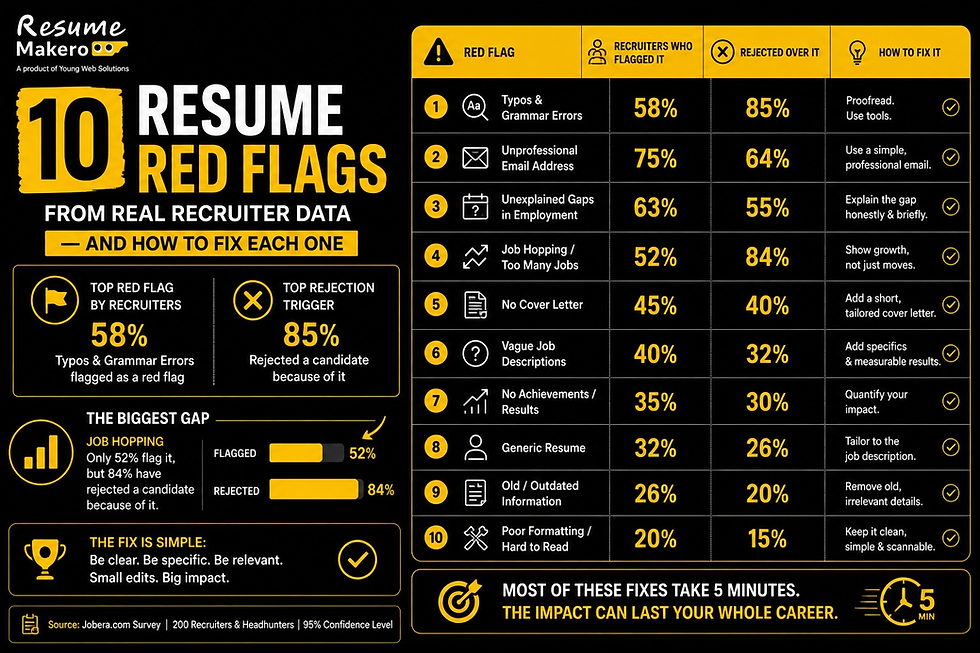
Myth #1: A creative, colorful resume gets you noticed. It might get you noticed by a human scrolling Pinterest. It does not help an ATS, and in many hiring pipelines, an ATS is the first filter before a human ever sees the document.
Myth #2: Tools like Canva are bad for resumes. Canva isn't bad — it's just not built for this specific job. Canva is a design tool first, and resumes made in heavily designed templates often use text boxes, columns, and graphics that parsing software struggles to read correctly. Great for a portfolio. Risky for a resume that needs to survive an ATS scan.
Myth #3: Multi-column layouts look organized, so they must be fine. Many ATS platforms read left to right, top to bottom, in a single linear flow. A two-column resume can get scrambled — your "Skills" section might get merged mid-sentence with your "Experience" section, and neither you nor the recruiter will know until it's too late.
Myth #4: Keyword-stuffing is the same as being qualified. Keywords matter because ATS software and recruiters both search for specific skills and job titles. But cramming in every buzzword from the job description without context reads as noise, not relevance — to both the software and the human reading it afterward.
Myth #5: A longer resume signals more experience. Recruiters spend an average of a few seconds on an initial resume scan. Length doesn't demonstrate impact — clarity does. A tightly written one-pager that clearly shows outcomes will consistently outperform a padded two-pager.
The pattern across all five myths is the same: resumes are optimized for people, but read by machines first. Understanding that gap is the actual skill — not finding a builder with the most template options.
What Makes a Resume Actually ATS-Friendly? (Checklist)
Single-column layout — no side-by-side text boxes
Standard section headers ("Experience," "Education," "Skills") instead of creative ones ("My Journey," "What I Bring")
No graphics, icons, or headshots embedded in text fields
Reverse-chronological work history with clear dates
Skills that match the specific job description's language
Simple, widely supported fonts — no decorative typefaces
Saved as a properly tagged PDF, not an image-based export
Want the full breakdown? Read our complete ATS Resume Guide for section-by-section formatting advice, or start building a free ATS-friendly resume on Resume Makero — no sign-up required.
The Hardest Feature Wasn't AI. It Was Trust.
Everyone assumes the hard part of building a resume tool is the AI. It wasn't.
The review engine was the first real wall. It's easy to bolt AI feedback onto a text field. It's much harder to make that feedback genuinely useful instead of generic filler like "consider adding more action verbs" repeated for the hundredth time. The suggestions had to reflect what actually gets resumes shortlisted, not just what sounds like good writing advice.
ATS compatibility was the second wall. Plenty of tools claim to be "ATS-friendly" as a marketing checkbox. Actually building around ATS parsing behavior — instead of just saying the words — meant testing real templates against real parsing logic, not assuming.
PDF generation, of all things, turned out to be its own battle. The exported document had to match exactly what the user saw while editing — same spacing, same formatting, no surprise reflow after download. It sounds like a small technical detail. It's the difference between a user trusting the tool enough to actually submit that resume for a real job, or not.
That's the theme underneath all three challenges: the hard part of building this product was never a feature. It was earning trust in twenty minutes or less, without a single onboarding call, testimonial page, or sales conversation to lean on.
Building Resume Makero Changed How We Build Software
Building your own product is uncomfortable in a way client work never is.
Nobody hands you a requirements document. Nobody signs off on your feature list.
Nobody tells you what "done" looks like. Users vote with exactly one action: leaving.
That discomfort taught us something that now shapes every product Young Web Solutions builds — whether it's a client CRM, an internal AI tool, or a booking system for a local business:
What's the smallest thing we can build that solves the biggest problem?
Not the most impressive thing. Not the thing with the most features. The smallest thing that actually removes friction for the person using it.
This matters beyond Resume Makero itself. Young Web Solutions isn't only a web design and development agency — we build full products. Resume Makero is proof of that: conceived, built, and launched as a real SaaS product, not a client deliverable. If you've worked with us for a website or an app before, this is the same team, applying the same product thinking to something we own end-to-end.
What's Next for Resume Makero
The current focus is on two things: an AI Resume Assistant that helps people write and improve content instead of manually filling every field, and an ATS Score feature that checks a resume against widely accepted ATS practices and explains, specifically, what to improve — not just a vague pass/fail grade.
Longer term, the goal goes beyond the resume itself. If someone has little to no internship or work experience, the plan is to surface relevant internship opportunities directly, through partnerships with internship platforms — so the resume isn't the finish line, the job actually is.
In the first week alone, Resume Makero crossed 300+ users and 70,000+ views through regional-language content — proof that "the market is too crowded" was never really the obstacle people assumed it was.
FAQ
Is Resume Makero really free?
Yes. There's no sign-up requirement, no paywall on downloads, and no watermark on PDF or DOCX exports.
Is Resume Makero ATS-friendly?
Yes — templates are built around widely accepted ATS parsing practices, not just labeled "ATS-friendly" as a marketing claim.
Who is Resume Makero best for?
Students, fresh graduates, interns, and early-career professionals who want a clean, ATS-ready resume quickly. It's less suited to highly visual portfolio resumes, like those used by graphic designers or art directors.
Does Young Web Solutions only build websites?
No. Young Web Solutions builds full digital products — websites, apps, and SaaS tools like Resume Makero — for both clients and its own ventures.
The Actual Point
None of this is really about resume builders.
It's about a pattern that shows up everywhere in product building: most tools get worse as companies try to monetize every step of a process that used to be simple. The opportunity usually isn't in adding one more feature. It's in asking what can be removed until only the useful part is left.
That's the lens Young Web Solutions brings to every product it builds — resume tools, client platforms, or otherwise. Not "what can we add to impress someone in a demo," but "what's the smallest, most trustworthy version of this that actually works."
If you're building a product and want a second opinion on where the actual friction is hiding, that's a conversation worth having early — before the build, not after.
Or if you just need a resume right now, no account required: