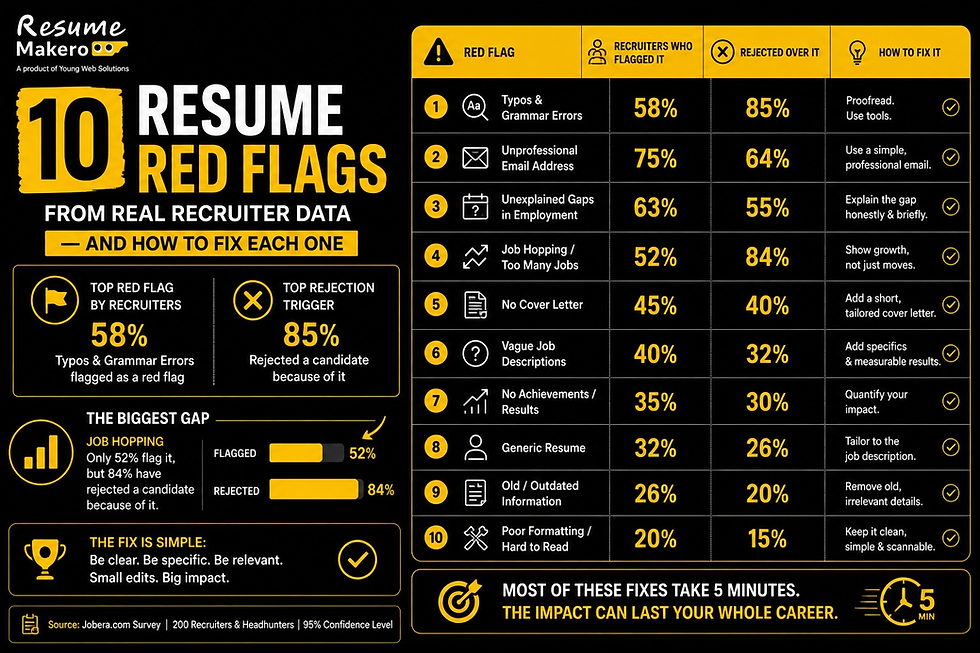
How Many Jobs Should You Apply to Per Day? A Realistic Strategy That Actually Gets Interviews

If you've been job hunting for more than a week, you've probably seen at least one LinkedIn post that goes something like this:
"After 873 applications, 41 rejections, 19 interviews, and enough coffee to keep Starbucks in business, I finally got an offer!"
The comments fill up with clapping emojis, congratulations, and "Never give up!"
What nobody talks about is whether sending 873 applications was actually a good strategy in the first place.
A few months ago, I spoke to a fresher who proudly showed me his Excel sheet.
"Look," he said. "I've already applied to 312 jobs."
I asked him one question.
"How many interviews?"
He paused.
"Three."
That conversation stuck with me because I've seen the same story repeat itself over and over again. Somewhere along the way, job hunting became a numbers competition. Freshers celebrate hitting 500 applications as if recruiters hand out loyalty points.
They don't.
After reviewing resumes and hiring interns, designers, marketers, developers, and content writers for my own agency, I've realised something that completely changed how I think about job searching.
The candidates who got interviews weren't usually the ones who applied to the most jobs.
They were the ones who made every application feel like it was written specifically for that company.
And that's exactly what this guide will help you do.
TL;DR
Don't have time to read the full guide? Here's the short version.
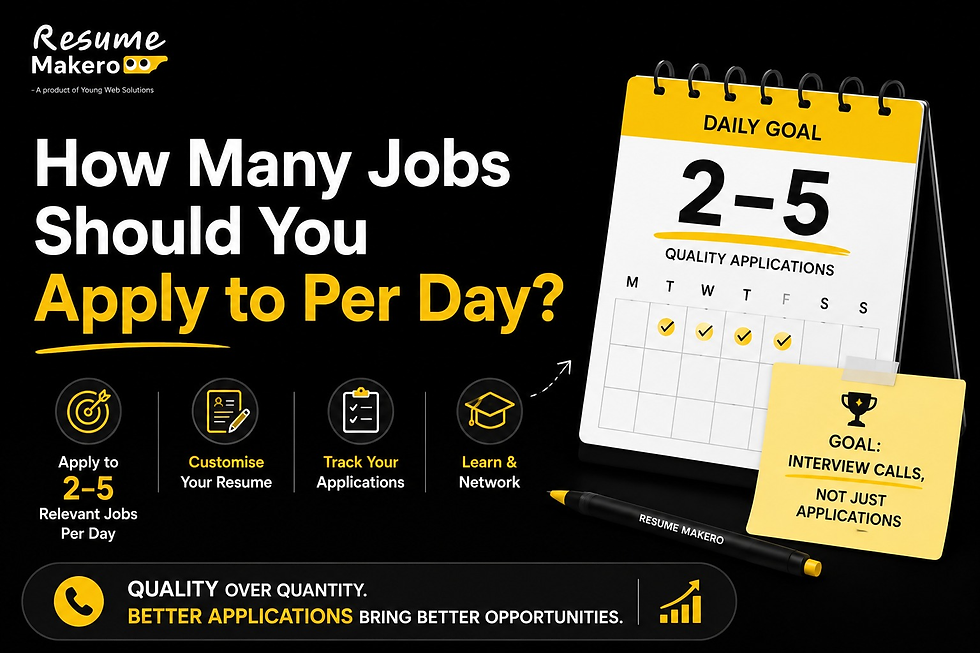
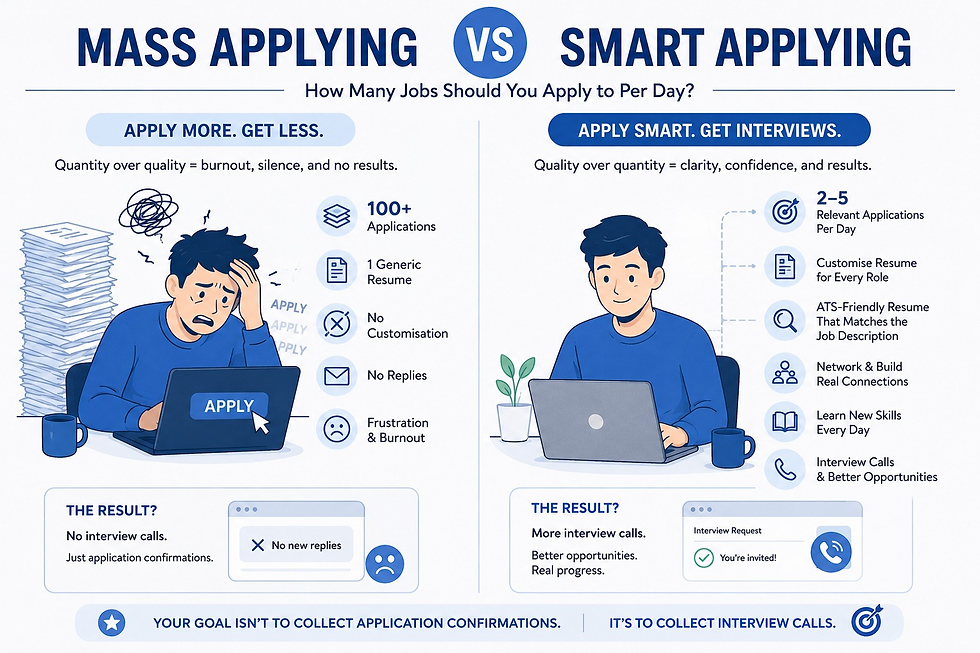
Apply to 2–5 relevant jobs per day, not 30 random ones.
Spend more time improving each application than increasing the number of applications.
Customise your resume for every important role.
Use an ATS-friendly resume that matches the job description.
Track your applications so you know what's working.
Spend at least as much time learning new skills and networking as you do applying.
Your goal isn't to collect application confirmations.
It's to collect interview calls.
Key Takeaways
✔ More applications don't automatically mean more interviews.
✔ Recruiters receive hundreds of resumes for many entry-level roles, so relevance matters more than volume.
✔ A tailored resume usually performs better than sending the same resume everywhere.
✔ If you're applying to hundreds of jobs without hearing back, your resume or strategy probably needs work—not your motivation.
✔ Building projects, networking, and learning new skills often improve your chances faster than submitting another 50 applications.
In This Guide
How many jobs should you apply to each day?
Why "Easy Apply" isn't always easy.
What recruiters actually notice.
The biggest mistakes freshers make.
My daily job search strategy.
Frameworks that helped candidates get interviews.
Common myths about job hunting.
FAQs.
Let's Get One Thing Out of the Way
No, applying to 100 jobs a day isn't a badge of honour.
I know that sounds harsh.
But hear me out.
If I asked you to cook dinner for ten guests, would you rather serve ten dishes you carefully prepared or one hundred half-cooked rotis?
Exactly.
Job applications work the same way.
When you rush through dozens of applications, you're usually skipping the parts that actually matter.
You're not reading the job description.
You're not changing your resume.
You're not writing a cover letter.
You're simply clicking Apply, hoping one company says yes.
Hope is not a strategy.
If I were graduating today and looking for my first full-time job, I'd aim for 2 to 5 high-quality applications every day.
That's roughly:
10–20 applications per week
40–80 applications per month
Now before you say, "Only five?", let me explain.
Every application should involve reading the job description, checking whether you're actually a good fit, tweaking your resume, and writing a short personalised cover letter if needed.
That takes time.
If you're genuinely doing all of that, you'll struggle to submit more than four or five quality applications in a day.
And that's perfectly okay.
I'd much rather send four applications that actually stand out than forty that recruiters forget five seconds later.
What the Research Says
This isn't just my opinion.
Career experts generally recommend 10–15 quality applications per week, or roughly 2–3 targeted applications per day, because it gives candidates enough time to customise their resumes and cover letters for each role. Research also shows that many employers use Applicant Tracking Systems (ATS), making relevance and keywords more important than mass applying.
Recent discussions among recruiters also reveal that entry-level roles often receive hundreds of applications, making it impossible for hiring teams to manually review every resume in depth.
Sources
Indeed Career Guide
LinkedIn Hiring Insights
Recruiter discussions on Reddit (community experiences)
The Biggest Mistake I See Freshers Make
Most freshers think they're losing because they aren't applying enough.
I think they're losing because they're applying without a strategy.
Here's what usually happens.
A student opens LinkedIn.
Filters by "Entry Level."
Sees 40 openings.
Clicks Apply.
Then repeats the same process on Naukri, Indeed, Foundit, Wellfound, and Internshala.
By the end of the day they've sent 35 applications and feel incredibly productive.
But if I asked them one question—
"How many resumes did you use today?"
—the answer is almost always the same.
"One."
That's where the problem starts.
Using the same resume for a Digital Marketing role, HR Executive role, Business Analyst role, and Customer Support role is like wearing the same outfit to a wedding, a cricket match, and a swimming pool.
Technically, you're dressed.
Practically, you've misunderstood the assignment.
Here's What Recruiters Actually Want
When I started hiring, I assumed I'd shortlist the candidates with the highest grades.
That wasn't what happened.
Some of the best candidates had average marks but excellent projects.
Others had no internship experience but had built personal websites, managed college events, or freelanced for small businesses.
Those resumes answered one important question.
"Can I imagine this person doing this job?"
The weaker resumes had a different problem.
They tried to become everything.
One resume claimed the candidate was interested in:
Finance
HR
Marketing
Graphic Design
Sales
Content Writing
That's not versatility.
That's confusion.
Recruiters don't expect you to know exactly what you'll be doing for the next twenty years.
But they do expect you to know why you're applying for this role.
Founder Note
One of the easiest ways to improve your interview rate is to stop trying to impress everyone.
Every time I've shortlisted a resume, it felt obvious why that candidate had applied.
Every time I've rejected one, it usually felt generic.
Specific resumes beat impressive-looking resumes almost every single time.
Why "Easy Apply" Can Be Misleading
Don't get me wrong.
I love Easy Apply.
It's convenient.
It's quick.
It removes unnecessary forms.
But it's also created a false sense of productivity.
Clicking "Apply" takes less than a minute.
Building a strong application takes much longer.
I've met candidates who proudly tell me they applied to 80 jobs over the weekend.
When I ask how many resumes they customised, they laugh.
That's exactly why they're struggling.
Easy Apply makes submitting applications easier.
It doesn't make getting hired easier.
The Resume Test I Use
Whenever I review a resume, I ask myself four simple questions.
If I can answer all four within the first minute, the candidate usually moves forward.
Can I immediately tell what role they're applying for?
Do they have relevant skills?
Have they done anything that proves those skills?
Can I imagine introducing them to my team?
Notice what's missing?
CGPA.
Favourite colour.
Five-star skill bars.
A progress meter showing "Leadership – 93%."
I have no idea how someone measures leadership to the nearest percentage, and I'm fairly sure recruiters don't either.
Stop Counting Applications. Start Tracking Results.
There's a metric I care about much more than applications sent.
Interview rate.
If you've applied to 100 jobs and received 15 interviews, you're doing something right.
If you've applied to 400 jobs and received two interviews, applying to another 400 probably isn't the answer.
It's time to pause and ask tougher questions.
Is my resume relevant?
Am I applying for the right roles?
Do I actually meet the requirements?
Am I tailoring my applications?
Could my resume be getting filtered out by ATS?
Those questions are uncomfortable.
They're also the ones that lead to better results.
My 5-5-5 Job Search Method
When freshers ask me how they should spend their day, I don't tell them to apply to more jobs. I tell them to build a system.
The biggest difference between candidates who eventually get hired and candidates who burn out isn't intelligence—it's consistency. A good system keeps you moving forward even on days when you don't receive interview calls.
Here's the framework I'd follow if I were looking for my first job today.
The 5-5-5 Method
Every day, aim to complete these three tasks:
Apply to 5 Relevant Jobs
Not just any five jobs.
Read the description, understand what the company wants, and ask yourself one question before applying:
"Can I honestly explain in an interview why I'm a good fit for this role?"
If the answer is no, skip it. Not every opening deserves your application.
Spend 50 Minutes Improving Your Resume
Notice I didn't say "rewrite your resume."
Improve it.
Add a better project description.
Replace weak action verbs.
Match keywords from the job description.
Quantify achievements wherever possible.
Small improvements every day create a much stronger resume after a month.
Make 5 Professional Connections
Reach out to seniors, alumni, recruiters, or professionals working in your target industry.
Don't ask them for a job immediately.
Instead, introduce yourself, mention why you reached out, and ask a thoughtful question.
For example:
Hi Aditi, I came across your profile while researching digital marketing careers. I'm a recent graduate trying to build my career in this field. I noticed you've worked at two agencies I admire. I'd love to know what skill helped you the most in landing your first role.
That's a conversation.
"Hi, can you refer me?" isn't.
The 70% Rule
Here's another mistake I see almost every week.
A candidate reads a job description.
They match eight out of ten requirements.
Then they stop because they don't know the remaining two.
Please don't do that.
Job descriptions usually describe the ideal candidate—not the only candidate.
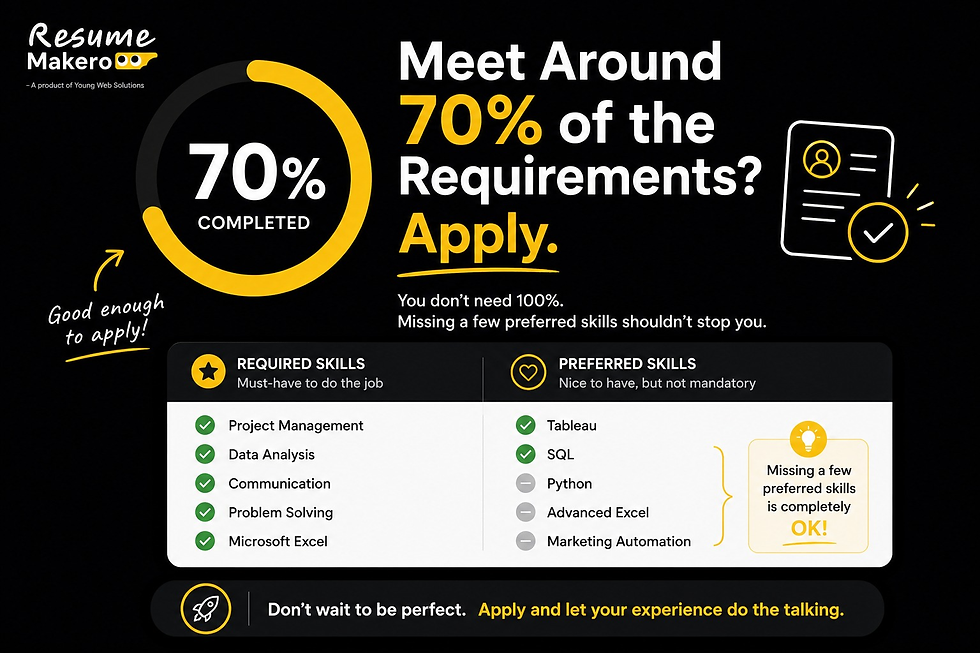
If you genuinely meet around 70% of the requirements, apply.
The worst outcome is a rejection.
The best outcome is an interview you never would have received if you had rejected yourself first.
The only exception is when the missing requirements are fundamental to the role. If a software engineering job requires Java and you've never written a single line of Java, it's probably not the right fit. But if you're missing one tool or one certification that you can learn quickly, don't let that stop you.
The Interview Ratio That Tells You What's Wrong
Most people measure only one thing:
Applications sent.
I measure four.
Stage | Healthy Sign |
Applications | You're applying consistently |
Recruiter Replies | Your resume is attracting attention |
Interviews | You're matching the right roles |
Job Offers | Your interview skills are working |
Here's why this matters.
Scenario 1: No Replies
You've applied to 100 jobs.
Nobody responds.
That usually points to one of three problems:
Your resume isn't ATS-friendly.
You're applying to unsuitable roles.
Your resume isn't showing relevant skills clearly.
Applying to another 100 jobs won't fix those issues.
Scenario 2: Lots of Interviews, No Offers
This is actually good news.
It means your resume is doing its job.
Now your focus should shift to interview preparation, communication, and confidence.
Scenario 3: A Few Replies, A Few Interviews
Congratulations.
Your strategy is working.
Keep refining it instead of changing everything after every rejection.
Things You Should Do Besides Applying
This might surprise you.
If all you're doing is applying for jobs, you're probably wasting a lot of time.
The best candidates improve while they search.
Here's how I'd split a typical day.
Activity | Time |
Searching for suitable jobs | 30 mins |
Tailoring resumes and applying | 90 mins |
Learning an in-demand skill | 60 mins |
Networking | 30 mins |
Interview preparation | 30 mins |
This approach gives you something valuable every day.
Even if you don't receive an interview call today, you've still improved your resume, learned a skill, and expanded your network.
That's progress.
Five Job Search Myths I Wish Freshers Would Stop Believing
Myth 1: "The More Jobs I Apply To, The Better."
Not necessarily.
I'd rather see someone send 15 thoughtful applications than 150 generic ones.
Recruiters notice effort.
Myth 2: "My CGPA Is Too Low."
I've hired candidates because of excellent portfolios and rejected candidates with higher grades because they couldn't demonstrate practical skills.
Grades matter.
They're just not the only thing that matters.
Myth 3: "I Need Experience Before I Can Apply."
Everyone starts somewhere.
If you don't have work experience, build projects, volunteer, freelance, contribute to open-source work, or participate in competitions.
Experience doesn't always come with a salary.
Myth 4: "ATS Rejects Every Resume."
ATS isn't your enemy.
Poorly structured resumes are.
Use clear headings, readable fonts, relevant keywords, and avoid unnecessary graphics.
Myth 5: "Networking Feels Fake."
Networking isn't about collecting contacts.
It's about building relationships before you need help.
The people you genuinely stay in touch with are often the first to tell you about opportunities.
Related Guides
Job hunting isn't just about sending resumes. These guides will help you improve every part of the process.
Frequently Asked Questions
How many jobs should I apply to every day?
For most freshers, 2–5 targeted applications per day is a realistic goal. Focus on quality rather than quantity.
Should I customise my resume every time?
Yes.
You don't need to rewrite everything, but updating your summary, skills, keywords, and relevant projects for each role can significantly improve your chances.
Is it okay to apply for multiple jobs at the same company?
Yes, provided the roles are closely related.
Applying for Digital Marketing Executive and Content Writer makes sense.
Applying for Accountant, HR Executive, and Graphic Designer at the same company usually doesn't.
What if I don't hear back after applying?
Don't assume you're doing everything wrong.
Hiring timelines vary, but if you've applied to dozens of suitable jobs without any response, review your resume before sending more applications.
Do I need a cover letter?
If the employer asks for one, always include it.
Even when it's optional, a short, personalised cover letter can help you stand out—especially for internships, startups, and smaller companies.
Should I apply if I don't meet every requirement?
Yes.
If you meet roughly 70% of the essential requirements and can demonstrate your willingness to learn, it's usually worth applying.
Your Action Plan for This Week
Reading career advice is useful.
Acting on it is what changes your job search.
Here's what I'd recommend you do over the next seven days.
Update your resume using an ATS-friendly format.
Create two tailored resume versions for the roles you're targeting.
Apply to 15–20 relevant jobs instead of 100 random ones.
Reach out to five alumni or professionals in your field.
Complete one certification or project that strengthens your profile.
Review your interview answers before your first interview invitation arrives.
Don't wait until you get an interview call to start preparing for it.
Final Thoughts
If there's one lesson I've learned from hiring, it's this:
The candidates who eventually get hired aren't always the smartest, the most experienced, or the ones with the highest grades.
They're usually the ones who stay consistent, keep improving, and make it easy for recruiters to see why they're a good fit.
Don't measure your job search by the number of applications you've sent.
Measure it by the quality of those applications, the interviews you're earning, and the skills you're building along the way.
Your first job probably won't come from your 500th application.
It will come from the application that was written with care, matched the role, and showed a recruiter exactly why you deserved an interview.
If you're about to start applying, make sure your resume gives you the best possible chance. Resume Makero helps you create ATS-friendly resumes with professionally designed templates, role-specific examples, guided writing tips, and free downloads. Instead of spending hours fixing formatting issues, you can focus on preparing for the interview that could change your career.
Sources
Indeed Career Guide – FAQ: How Many Applications Does It Take To Get a Job?
LinkedIn Talent Blog and Hiring Insights (hiring trends and recruiter behaviour)
Reddit discussions from recruiters and job seekers (used as community experiences, not definitive evidence)
Google recruiter resume guidance reported by Economic Times
U.S. Bureau of Labor Statistics (job search and employment trends)