
What Should a Resume Look Like to Get Hired?
Updated: Jul 28
TL;DR
After reviewing more than 1,000 job applications, we've found that the resumes most likely to earn interviews have these things in common:
• Typos, grammar mistakes, and generic skill lists can quickly hurt your chances.
• Projects, GitHub repositories, portfolios, and proof of work make resumes more credible.
• Quantified achievements are more persuasive than vague responsibilities.
• For software and startup roles, practical experience often matters more than GPA or certifications.
• Keep your resume simple, ATS-friendly, and focused on relevant experience.
• A strong resume answers one question quickly: can you do the job?

If you search for resume advice online, you'll find hundreds of articles telling you to use certain templates, keywords, or formatting tricks.
After reviewing more than 1,000 job applications over the past three years at Young Web Solutions, our software and marketing company, I've learned that most hiring decisions come down to something much simpler:
Can you quickly demonstrate that you have the skills and experience needed for the role?
Those hiring experiences eventually led us to build Resume Makero, a free ATS-friendly resume builder designed to help students, fresh graduates, interns, and professionals create better resumes.
This article is based on what we've observed while hiring in a startup environment. Larger enterprises, consulting firms, and specialized industries may evaluate candidates differently, but these are the patterns we've consistently seen among candidates who earn interviews.
If you're a fresh graduate or a software engineer with a few years of experience, here's what your resume should actually look like.
The Biggest Resume Mistakes We See
Let's start with what hurts candidates the most.
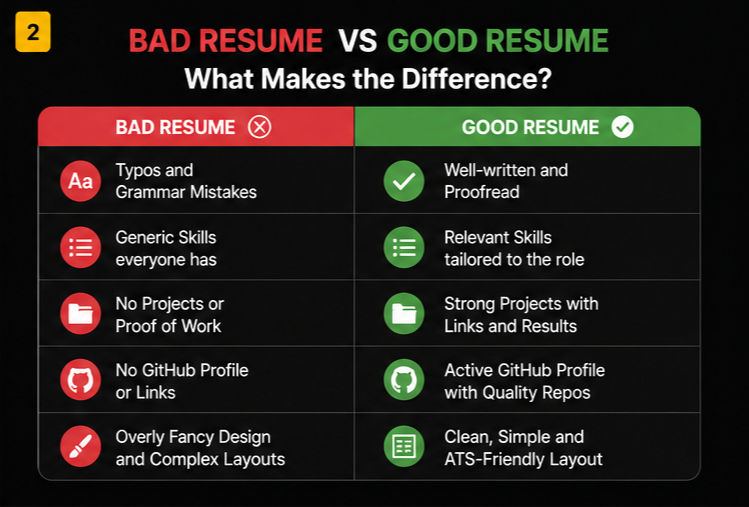
1. Typos and Grammar Mistakes
This sounds obvious, but it's one of the most common issues.
A resume is one of the few documents a candidate has complete control over. When it contains spelling mistakes, grammar errors, or inconsistent formatting, it creates doubt about attention to detail.
Before submitting your resume, review it multiple times and ask someone else to proofread it.
2. Generic Skills Sections
Many resumes contain long lists of tools such as:
Excel
VS Code
Visual Studio
Microsoft Word
PowerPoint
These rarely help candidates stand out.
Most employers assume applicants know the basic tools required to perform their work.
Instead of listing every tool you've used, focus on skills that are directly relevant to the role you're applying for.
3. No Projects or Proof of Work
This is especially common among fresh graduates.
Many candidates claim proficiency in technologies but provide no evidence of how they've used them.
If you don't have professional experience yet, projects become your experience.
Without projects, hiring managers have very little information to evaluate.
What Makes a Resume Stand Out
After reviewing more than 1,000 applications, the strongest candidates usually have several things in common.
Strong Projects With Links
Projects immediately make a resume more credible.
A good project demonstrates:
Problem-solving ability
Technical knowledge
Initiative
Execution
Whenever possible, include links to:
GitHub repositories
Live applications
Portfolio websites
Case studies
Make it easy for employers to verify your work.
A GitHub Profile
For software engineering roles, GitHub can be one of the strongest indicators of technical ability.
An active GitHub profile helps employers understand:
What you've built
How you structure code
The technologies you use
Your consistency over time
In our startup hiring process, a strong GitHub profile has often been a more useful signal than GPA alone.
Quantified Achievements
Avoid writing vague statements.
Instead of:
Built a web application.
Write:
Built a web application used by 1,000+ users.
Instead of:
Improved website performance.
Write:
Reduced page load time by 35%.
Numbers provide context and make accomplishments more believable.
Relevant Experience
Experience doesn't always mean a full-time job.
Valuable experience can include:
Internships
Freelance work
Contract projects
Open-source contributions
Client work
These experiences demonstrate that you've applied your skills in real-world situations.
Clear Career Progression
For experienced candidates, employers want to quickly understand how responsibilities and skills have evolved over time.
A resume should make that progression easy to follow.
What Matters Most in Startup Hiring
If I had to choose between two similar candidates, these factors would strongly influence my decision.
GitHub Over GPA
Academic performance can be useful information.
However, for software roles, a GitHub profile often provides a much clearer picture of a candidate's capabilities.
A strong repository demonstrates practical skills. GPA demonstrates academic performance.
In many startup environments, practical skills carry more weight.
Real Projects Over Certifications
Certifications are not useless.
They can demonstrate initiative and a willingness to learn.
However, for software development roles, real projects generally provide stronger evidence of ability.
A certification shows you've completed a course.
A project shows you've applied what you've learned.
Internship Experience Over Long Skill Lists
Anyone can list twenty technologies.
What stands out is showing how those technologies were used to solve real problems.
Experience creates credibility.
Does College Matter?
Many students worry that attending an average college automatically puts them at a disadvantage.
In our experience, that isn't necessarily true.
We've interviewed and seriously considered candidates from lesser-known colleges because they had:
Strong projects
GitHub portfolios
Internship experience
Freelance work
Demonstrated technical ability
While some larger organizations may place greater emphasis on university reputation, startups are often more interested in what you've built than where you studied.
The Resume Structure I'd Recommend
A simple structure works best.

1. Header
Include:
Full name
Phone number
Email address
LinkedIn profile
GitHub profile
Portfolio website (if applicable)
2. Professional Summary
Keep it short.
In two to four lines, explain:
Who you are
Your specialization
Your experience level
The type of role you're seeking
3. Experience
Place experience immediately after your summary.
This is one of the first sections many hiring managers want to evaluate.
Include:
Full-time jobs
Internships
Freelance work
Contract work
Focus on achievements and outcomes rather than responsibilities.
4. Projects
For fresh graduates, this may be the most important section on the resume.
Include:
Project name
Technologies used
Problem solved
Measurable results
GitHub link
Live demo link
5. Skills
Keep this section focused and relevant.
Group technologies logically and avoid listing every tool you've ever used.
6. Education
Include:
Degree
Institution
Graduation year
7. Certifications
Include certifications only if they strengthen your application or are relevant to the position.
Do You Need a Fancy Resume Design?
Usually, no.
One of the biggest resume myths is that a visually impressive design will significantly increase your chances of getting hired.
For software engineering and most professional roles, content matters far more than design.
I generally recommend:
No photos
No graphics
No excessive colors
No complicated layouts
Clear section headings
Easy-to-read formatting
The exception is creative roles where design skills are part of the evaluation process.
For designers, branding professionals, and certain marketing roles, presentation may matter more.
For most candidates, simplicity wins.
Startup Hiring vs Enterprise Hiring
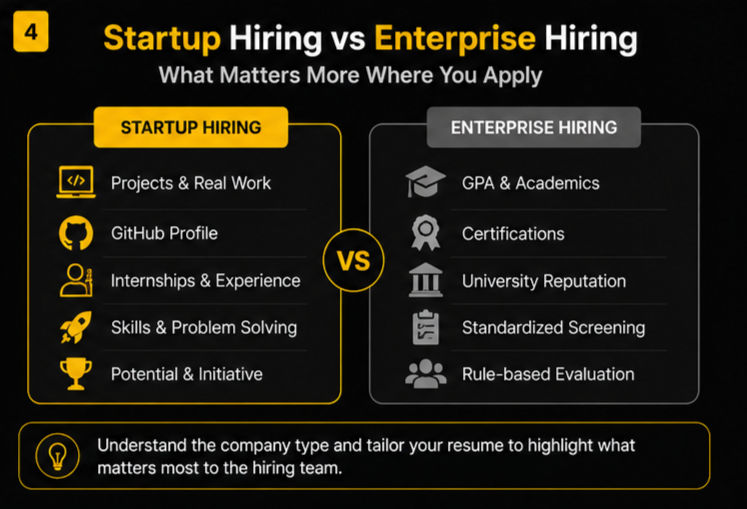
One thing many job seekers overlook is that hiring priorities vary between companies.
In startups, hiring managers often care more about:
Projects
GitHub profiles
Internships
Freelance work
Demonstrated skills
Large enterprises may place greater emphasis on:
GPA
University reputation
Certifications
Standardized hiring criteria
Understanding the type of company you're applying to can help you tailor your resume more effectively.
A Real Hiring Lesson
Some of the most impressive candidates we've encountered didn't have highly designed resumes or degrees from prestigious institutions.
What they did have was proof.
They showed us projects.
They shared GitHub repositories.
They demonstrated internship experience.
They had freelance work that reflected real responsibility.
Their resumes were simple, but their work spoke for itself.
Those candidates consistently stood out more than applicants with polished templates and very little evidence of practical ability.
Want to Apply These Resume Tips?
Knowing what makes a strong resume is one thing. Building one is another.
If you're creating a new resume or updating an existing one, focus on simplicity, relevance, and proof of work. Highlight your projects, experience, achievements, and skills in a format that's easy for recruiters and Applicant Tracking Systems (ATS) to read.
That's exactly why we built Resume Makero.
Resume Makero helps students, fresh graduates, interns, and professionals create ATS-friendly resumes, CVs, and cover letters for free. You can customize sections, reorder content, choose recruiter-friendly templates, review your document before downloading, and export it in PDF or DOCX format without creating an account.
The goal is simple: help job seekers spend less time fighting formatting issues and more time showcasing what makes them worth hiring.
Final Thoughts
The purpose of a resume isn't to look impressive.
The purpose of a resume is to establish credibility.
A hiring manager wants answers to a few simple questions:
Can this person do the job?
Have they demonstrated the necessary skills?
Have they built anything meaningful?
Have they applied those skills in the real world?
The strongest resumes answer those questions quickly.
Keep your resume clean. Eliminate mistakes. Showcase real work. Include project links. Maintain a strong GitHub profile. Focus on outcomes instead of responsibilities.
Because in startup hiring, evidence beats decoration almost every time.

Start creating resume for free: app.resumemakero.com About the Author
Team Resume Makero is part of Young Web Solutions, a software and marketing company that has reviewed more than 1,000 job applications over the past three years while hiring for technical and business roles. The insights shared in this article are based on real hiring experiences and observations from screening candidates across different skill levels and backgrounds.
Resume Makero was created to help students, fresh graduates, interns, and professionals build ATS-friendly resumes, CVs, and cover letters that focus on what employers actually look for.